


Business: business@xtoolonline.com
Social Media Cooperation: Media@xtoolonline.com
Support: support@xtoolonline.com

In the hyper-competitive logistics and transportation landscape of 2026, fleet managers are no longer just overseeing vehicles; they are managing mobile data centers. With rising labor costs, the increasing complexity of electronic control units (ECUs), and the transition toward hybrid and electric powertrains, the Total Cost of Ownership (TCO) has become the ultimate metric of survival.
Recent industry data suggests that unplanned downtime now accounts for up to 35% of total fleet operating costs. When a Class 8 truck sits idle in a bay, the loss isn't just the repair bill—it's the missed delivery windows, driver downtime, and lost reputation. To combat this, elite fleet operations are shifting away from "reactive" maintenance toward high-efficiency diagnostic strategies. At the heart of this shift is XTOOL Bi-Directional Control technology.
For the uninitiated, standard OBDII diagnostics are a one-way street: the tool asks a question, and the car provides an answer, usually in the form of a Diagnostic Trouble Code (DTC). Bi-Directional Control, also known as Active Tests or Actuation Testing, turns this into a two-way conversation.
It allows a technician to bypass the vehicle's control modules and send functional commands directly to specific components. Instead of wondering if a fuel pump is broken, you can use an XTOOL tablet to command the pump to turn "ON." If it whirs to life, you've instantly ruled out the pump and narrowed the fault to the wiring or the controller.
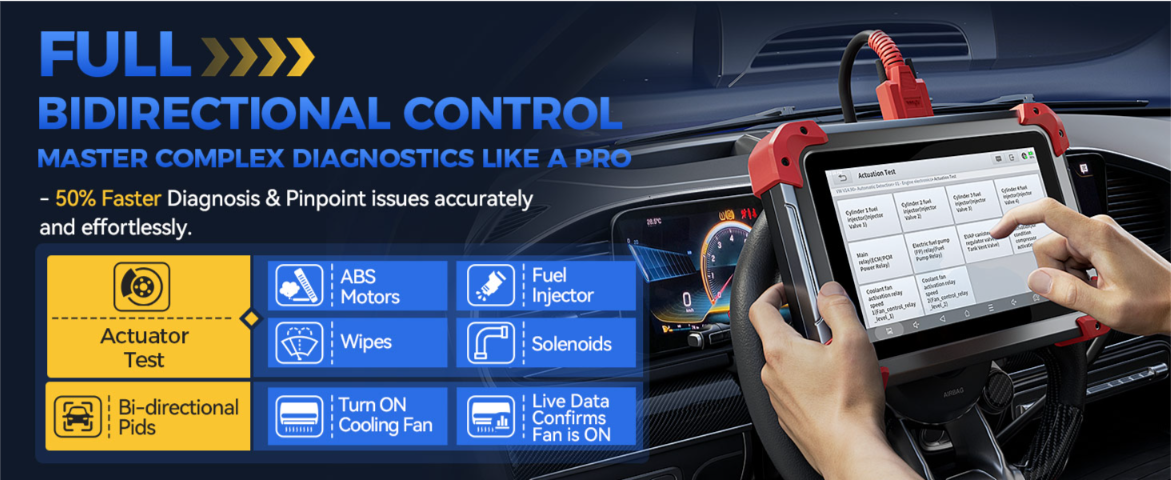
Common XTOOL Active Tests include:
Reducing TCO isn't about buying the cheapest tools; it's about maximizing the "yield" of every hour spent in the workshop. XTOOL helps achieve this through three primary mechanical levers.
Labor is the single most expensive variable in fleet maintenance. In 2026, the average shop rate has climbed significantly. Traditional "visual inspection" and "manual testing" of components like a turbocharger wastegate or a cooling fan can take hours of disassembly.
With XTOOL's advanced software architecture, a technician can trigger these components via the tablet in under 60 seconds. By cutting diagnostic time from four hours down to one, a fleet of 50 vehicles can reclaim hundreds of billable hours per year.
"Part darting"—the practice of replacing parts until the problem disappears—is a silent TCO killer. When a technician is unsure, they often replace a $500 sensor "just in case."
Bi-directional control provides the empirical evidence needed to justify a repair. If the XTOOL device commands an AC compressor clutch to engage and it fails to move despite receiving the signal, the technician can replace the part with 100% confidence. This precision reduces the "re-fix" rate and ensures that the fleet's parts budget is spent only on necessary repairs.
TCO is also dictated by the lifespan of the asset. XTOOL tools provide access to specialized reset and regeneration functions—such as DPF (Diesel Particulate Filter) Forced Regens and BMS (Battery Management System) Resets.
For large fleets, being able to perform a forced DPF regeneration in-house prevents the filter from clogging to the point of permanent damage, which can cost upwards of $3,000 to replace. By maintaining these systems proactively, you extend the service life of the vehicle and improve its eventual resale value.

To visualize the impact, let's look at a comparative analysis of common fleet repairs.
| Maintenance Task | Traditional Diagnostic Cost (Est.) | XTOOL Bi-Directional Cost (Est.) | TCO Savings (%) |
| Fuel System Troubleshooting | $450 (Manual testing + labor) | $120 (Instant actuation) | 73% |
| Brake System Bleeding/Tests | $300 (Two-man job) | $80 (Automated ABS cycle) | 73% |
| EV Battery Coolant Air Bleed | $550 (OEM Dealer Visit) | $150 (In-house XTOOL command) | 72% |
| Annual Unplanned Downtime | $5,000+ per vehicle | $1,800 per vehicle | 64% |
Note: Estimates based on average 2026 shop rates and component costs.
While OEM (Original Equipment Manufacturer) tools offer deep coverage, they often come with prohibitive annual subscription fees and "locked" ecosystems that don't play well with mixed fleets.
XTOOL has positioned itself as the "Value Champion" by offering OEM-level depth across 99% of global brands—including heavy-duty 24V trucks and the latest EVs—without the predatory pricing models of legacy brands. For a fleet manager, this means one tool can service a Ford Transit van, a Freightliner truck, and a Tesla Model 3 delivery vehicle.
Key Hardware Advantages:
Owning the tool is only half the battle. To truly lower TCO, XTOOL must be integrated into your Standard Operating Procedures (SOP):
In 2026, the difference between a profitable fleet and one that is bleeding cash is diagnostic efficiency. By leveraging XTOOL Bi-Directional Control, fleet managers can effectively slash labor costs, eliminate unnecessary parts spending, and keep their assets on the road longer.
Investing in bi-directional capability isn't just about fixing cars; it's about protecting your margin. If you are managing a large-scale fleet, the question isn't whether you can afford to upgrade to XTOOL—it's whether you can afford the cost of staying in the dark.
Q1: Can XTOOL bi-directional tools handle the Security Gateways (SGW) found on newer 2024-2026 vehicles?
A: Yes. XTOOL devices are equipped with native CAN-FD and DoIP protocols and support authorized access for FCA (Stellantis), Renault, and Nissan security gateways, ensuring your fleet isn't locked out of modern vehicles.
Q2: Is the bi-directional control limited to certain modules?
A: XTOOL provides full-system bi-directional control. This includes not just the PCM (Engine) and TCM (Transmission), but also the BCM (Body), ABS, SRS, Chassis, and even Infotainment modules.
Q3: How does XTOOL compare to "Big Name" brands like Autel or Snap-On for fleet use?
A: While all three provide bi-directional support, XTOOL is often cited for having a faster UI and better "price-to-performance" ratio. For large fleets needing to kit out multiple bays, XTOOL allows for a larger deployment of tools for the same budget, without sacrificing the depth of active tests.


Business: business@xtoolonline.com
Social Media Cooperation: Media@xtoolonline.com
Support: support@xtoolonline.com