


Business: business@xtoolonline.com
Social Media Cooperation: Media@xtoolonline.com
Support: support@xtoolonline.com

In the modern American automotive landscape, a vehicle is no longer just a mechanical assembly of steel and glass; it is a mobile supercomputer. For collision repair shop owners and fleet managers across the United States, this shift has fundamentally changed the "rules of engagement" with insurance adjusters. The days of visual estimates are over. Today, the most critical tool in your shop isn't a frame rack or a spray booth—it is the Digital Evidence provided by pre-and-post scan reports.
In the U.S. market, insurance claims are driven by data, not just physical damage. A Pre-scan identifies electronic faults caused by the collision, while a Post-scan verifies the restoration of all safety systems. Without these reports, shops face non-payment risks and massive legal liabilities.
According to I-CAR (Inter-Industry Conference on Auto Collision Repair), scanning a vehicle is no longer "optional"—it is a required step for any vehicle involved in a collision. Insurance adjusters from major carriers like State Farm or GEICO operate on a "show me the data" basis. If you cannot provide a timestamped report showing a fault code (DTC) tied to the VIN, the adjuster will likely label the repair as "unsubstantiated" and strike it from the estimate.
A mid-sized repair shop in Texas that repaired a 2024 SUV with minor front-end damage. The shop skipped the pre-scan because "no dash lights were on." They replaced the bumper and grille, then returned the car. Two weeks later, the customer was involved in a minor fender bender, and the side curtain airbags failed to deploy. The subsequent investigation found a "Pending Code" in the SRS (Supplemental Restraint System) module that existed from the first accident but was never detected. The shop faced a multi-million dollar negligence lawsuit because they lacked a digital "clean bill of health" (Post-scan) from the first repair.
Most shop owners view scanning as a way to bill an extra $50-$100 to the insurance company. This is a narrow perspective. The true value of the scan is Liability Transfer. By documenting the state of every ECU (Electronic Control Unit) before and after the repair, you are legally drawing a line in the sand. You are proving exactly what was broken by the accident and exactly what was fixed by your team.
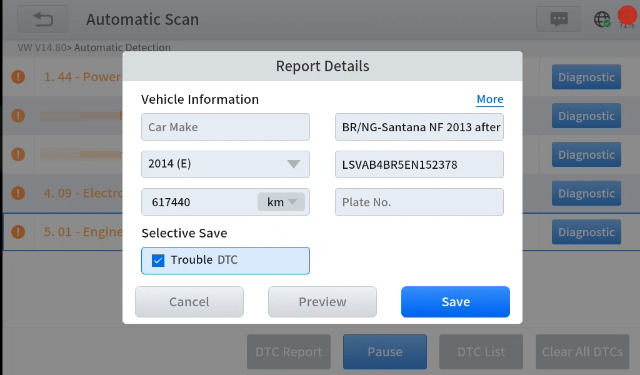
Professional diagnostic tools like XTOOL generate comprehensive, unalterable PDF reports that include VIN data, timestamps, and full system status. These documents serve as the primary negotiation leverage when dealing with stubborn insurance adjusters.
An effective report for an insurance claim must be professional and "adjuster-proof." Standard OBD2 code readers are insufficient because they often only scan the PCM (Engine Module). Professional-grade tools, perform "All-System" scans. These reports include:

It is important to acknowledge the limitations: A report is only as good as the technician interpreting it. If a scan shows a "Communication Error" with a radar sensor, the tool has done its job. However, if the technician fails to check the OEM repair manual to see if that sensor requires a specialized bracket or a specific calibration sequence, the insurance company may later recoup the payment during an audit. Documentation proves the existence of a fault, not the quality of the physical repair.
Data indicates that utilizing pre-scans to uncover "Hidden DTCs" (such as sensor misalignments or wiring harness issues) increases the average claim settlement by $200–$800 through legitimate supplements.
In the U.S. collision industry, "Supplements" (additional repair costs found after the initial estimate) are where shops maintain their margins. CCC Intelligent Solutions 2025 data suggests that vehicles receiving a comprehensive pre-scan have a 15% faster claim cycle. Why? Because the "Hidden Damage" is identified on Day 1, rather than Day 10.
| System Type | Hidden Fault Frequency | Avg. Claim Increase (Est.) |
| ADAS Sensors | 65% | $350 - $500 |
| SRS/Airbag Modules | 30% | $500 - $1,200 |
| Blind Spot Monitoring | 45% | $250 - $400 |
A pro-tip for American shops: When using your XTOOL device, always pull the Freeze Frame Data. This data shows the exact mileage, speed, and engine conditions when a fault code was triggered. If an adjuster claims a sensor failure is "Normal Wear and Tear," the Freeze Frame data showing the fault occurred at the exact moment of impact is your "Smoking Gun" to get the supplement approved.
The Post-scan is your "Certificate of Completion." it confirms that all safety systems are active and no new faults were introduced during the repair process, effectively transferring risk back to the vehicle owner and insurer.
Many modern Advanced Driver Assistance Systems (ADAS) will not trigger a light on the dashboard even if they are malfunctioning. For example, a lane-departure camera that is off by just 1 degree will not show a warning light but will fail to steer the car correctly in an emergency. A post-scan verifies that the system is "Ready" and calibrated.
The industry often preaches "Follow the OEM Procedures." While this is the gold standard, the reality in a high-volume US shop is that time is money. Using a tool that can perform a Rapid Post-Scan Health Check in under 5 minutes—like the XTOOL wireless series—allows you to maintain safety without killing your flat-rate technicians' productivity.

Integrating pre-and-post scan reports into your workflow is no longer just a technical requirement—it is a business strategy. By using high-quality diagnostic tools to generate unassailable evidence, American repair shops can protect their customers, maximize their insurance reimbursements, and shield themselves from legal liability.
Q: Will insurance companies pay for both scans?
A: Generally, yes. Most major U.S. carriers accept the "Pre-scan" as a diagnostic necessity and the "Post-scan" as a quality control necessity, provided you provide a professional PDF report.
Q: Can I use a basic code reader for these reports?
A: No. Basic readers often miss manufacturer-specific codes in the Airbag, ABS, and ADAS modules. Insurance adjusters require "All-Module" reports that include the VIN.
Q: How do I handle an adjuster who refuses to pay?
A: Present the OEM Position Statement (e.g., from Honda, Ford, or Toyota) alongside your XTOOL Pre-scan report. It is very difficult for an adjuster to argue against the manufacturer’s own safety requirements.


Business: business@xtoolonline.com
Social Media Cooperation: Media@xtoolonline.com
Support: support@xtoolonline.com